GEOTECHNICAL ENGINEERING1
SLOUGH
HomeInvestigationCPT (Cone Penetration Test)

CPT Testing in Slough – Cone Penetration Test for Ground Investigation

Sound ground. Sound decisions.

LEARN MORE

With over 160,000 people living on the London Clay that underpins much of the Thames Valley, Slough presents a textbook case for why detailed ground investigation matters. The town sits on the western edge of the London Basin, where the Lambeth Group sands and gravels often pinch out against the chalk, creating abrupt changes in bearing capacity over very short distances. Our laboratory team runs CPT (Cone Penetration Test) campaigns across the borough — from the Slough Trading Estate to new residential schemes near Langley — and we have seen firsthand how a continuous soil profile can catch a thin, weak silt lens that a borehole might miss entirely. When you need geotechnical data for foundation design in these variable deposits, the cone penetration test gives you that uninterrupted record of tip resistance and sleeve friction, letting you spot transitions between the stiff clay and the underlying dense sands without guesswork. For sites where the ground conditions are especially tricky, we often pair CPT probing with Shaft Friction Pile testing to validate the design parameters before construction begins.

A single CPT sounding in Slough's London Clay can replace three or four conventional boreholes when you need a continuous strength profile for pile design.
Our service areas

Scope of work

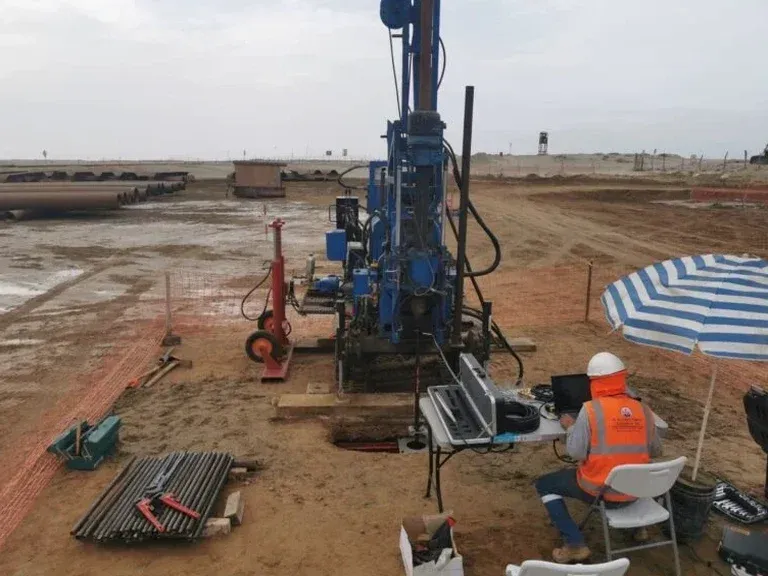
Every cone penetration test we perform in Slough complies with BS 5930:2015+A1:2020 for site investigation and BS EN ISO 22476-1:2012 for the CPT method itself. What makes this relevant locally is the high groundwater table across much of the Colne Valley — you can hit water at less than two metres depth in some postcodes, and that changes how you interpret pore pressure dissipation tests. Our 20-tonne CPT rig pushes a 60-degree conical tip at a constant rate of 20 mm/s, recording cone resistance (qc), sleeve friction (fs), and dynamic pore pressure (u2) in real time. The data loggers capture readings every 10 mm, so you see the full stratigraphic column emerge as the rods go down. We also run dissipation tests at predetermined depths to estimate the coefficient of consolidation, which becomes essential when your structural engineer needs to calculate settlement rates under load. The push rods are fitted with inclinometers to monitor verticality, and we automatically abort if the deviation exceeds 2 degrees — no point in paying for skewed data.
CPT Testing in Slough – Cone Penetration Test for Ground Investigation
Technical reference — Slough

Local geotechnical context

We worked on a logistics warehouse project near the M4 corridor where the initial desk study suggested uniform London Clay to 18 metres. The developer's foundation contractor had priced the job based on that assumption — continuous flight auger piles, straightforward installation. Our first CPT sounding told a different story. At 11.2 metres the tip resistance dropped from 8 MPa to less than 1.5 MPa across a band only 400 mm thick, and the friction ratio spiked. That was a water-bearing silt lens sitting right where the pile toes were supposed to end up. Had the piles terminated there, the settlement under the racking loads would have been significant. The CPT data allowed the design team to lengthen the piles by two metres and shift the bearing stratum into the competent clay below the silt. In Slough's mixed alluvial and residual soils, skipping the cone penetration test before finalising pile lengths is a gamble that can cost tens of thousands in remedial works.

Need a geotechnical assessment?

Reply within 24h.

Email: contact@geotechnical-engineering1.com

Relevant standards

BS 5930:2015+A1:2020 – Code of practice for ground investigations, BS EN ISO 22476-1:2012 – Geotechnical investigation and testing – Field testing – Part 1: Electrical cone and piezocone penetration test, Eurocode 7 (BS EN 1997-2:2007) – Geotechnical design – Part 2: Ground investigation and testing

Reference parameters

ParameterTypical value
Cone tip angle60° (standard electrical cone)
Penetration rate20 mm/s ± 5 mm/s
Maximum thrust capacity200 kN
Parameters recordedqc, fs, u2, inclination, depth
Data sampling interval10 mm along depth
Dissipation test durationUntil 50% pore pressure decay
Applicable standardBS EN ISO 22476-1:2012

Common questions

What does a CPT test cost in Slough?

For a standard CPT sounding in the Slough area, budget between £140 and £170 per metre of penetration. The final figure depends on the depth target, the number of dissipation tests you need, and how easy the access is. A typical 20-metre profile with two dissipation pauses runs around £2,800 to £3,400. We quote per metre so you only pay for what we actually push, and we include the factual report in that price.

How deep can the CPT rig push in London Clay?

Our 20-tonne truck-mounted rig can typically reach 25 to 30 metres in the stiff London Clay found across Slough, provided there are no dense gravel layers or cemented horizons. The actual refusal depth depends on the cone resistance — when qc consistently exceeds 50 MPa in very dense sands or gravels, we stop to avoid damaging the cone. If you need deeper profiles, we discuss combining CPT with cable percussion boreholes to extend the investigation depth.

How long does CPT testing take on a Slough site?

A single CPT sounding to 20 metres depth takes about 45 to 90 minutes of actual pushing time, plus setup and breakdown. We can typically complete three to four soundings in a standard working day, depending on how far apart the locations are and how much time you need for dissipation tests at each point. The factual report with all plots and logs is usually ready within three working days after the field work wraps up.

Location and service area

We serve projects in Slough and surrounding areas. More info.

View larger map