GEOTECHNICAL ENGINEERING1
SLOUGH

Geotechnical Engineering in Slough

Sound ground. Sound decisions.

LEARN MORE

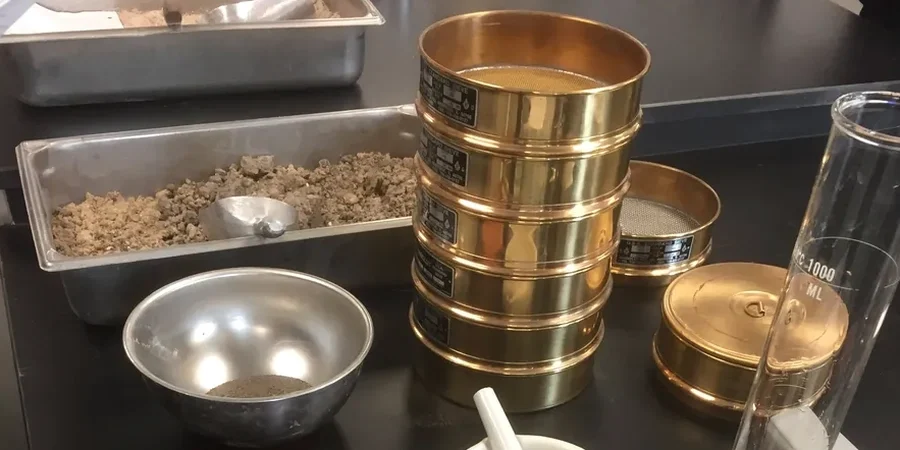
Slough sits on the western edge of the London Basin, where the Lambeth Group sands and silts transition into the stiff, overconsolidated London Clay that underlies most of the town. Ground investigation here rarely stops at simple bearing capacity — the interaction between the chalk aquifer at depth and the superficial gravel terraces creates perched water tables that distort effective stress profiles. A soil mechanics study defines the strength envelope, compressibility, and permeability of each unit before a single footing is poured. Without that resolution, settlement predictions on the variable brickearth deposits found across the Trading Estate become guesswork. We run the full physical and mechanical suite — Atterberg limits, triaxial compression, oedometer consolidation — calibrated against the grain-size distribution of the local fluvial sequence so that the stiffness parameters fed into the structural model actually match the ground.

Knowing that the London Clay at Slough has an overconsolidation ratio exceeding 10 changes the entire excavation support design.
Geotechnical Engineering in Slough
Technical reference — Slough

Our service areas

Local geology

The contrast between the northern wards around Cippenham and the central redevelopment zone near the station is stark. Cippenham sits on a thick mantle of Langley Silt over gravel, giving undrained shear strengths that degrade rapidly with remoulding; the station quarter overlies dense Taplow Gravel directly on chalk, where bearing resistance is high but pile refusal depths are erratic. A proper soil mechanics study captures both conditions: we run consolidated-undrained triaxial tests with pore pressure measurement on Shelby tube samples from the silt, then switch to multistage CU on the gravel remoulded to field density. Consolidation parameters from incremental oedometer loading define the time-rate of settlement under the sustained floor loads common in Slough’s logistics warehouses. The report presents critical state parameters — λ, κ, M — not just index numbers, so the designer can model the ground realistically in PLAXIS or similar.

Relevant standards

BS 5930:2015+A1:2020 — Code of practice for ground investigations, Eurocode 7: BS EN 1997-2:2007 — Ground investigation and testing, BS 1377:2022 — Methods of test for soils for civil engineering purposes, BS EN ISO 17892:2014 — Geotechnical investigation and testing — Laboratory testing of soil

Need a geotechnical assessment?

Reply within 24h.

Email: contact@geotechnical-engineering1.com

Why choose us

The triaxial cell in our lab runs a Slough silt specimen through the shearing stage while the pore pressure transducer logs the excess pressure that triggers failure. If that reading is misinterpreted — or worse, not measured at all because only a quick undrained test was specified — the designer assumes a drained friction angle that does not exist in the field. On the tight brownfield sites along the Bath Road corridor, where a 4-metre cut sits within two metres of an existing warehouse slab, that mistake translates into a slip circle daylighting in the neighbour’s floor. BS EN 1997-2:2007 mandates effective stress triaxial testing with pore pressure measurement for any project where the groundwater regime influences stability. We run every stage — saturation, consolidation, shear — under the rates dictated by the coefficient of consolidation from the oedometer, not a generic lab default.

Reference parameters

ParameterTypical value
Undrained shear strength (su) — London Clay60–150 kPa (depth-dependent)
Plasticity index — weathered London Clay25–45%
Coefficient of volume compressibility (mv)0.05–0.15 m²/MN
Effective friction angle (φ') — Taplow Gravel34°–38° (dense)
Permeability — Langley Silt1×10⁻⁸ to 1×10⁻⁹ m/s
Overconsolidation ratio (OCR)10–30 (London Clay)

Common questions

What does a soil mechanics study cost for a typical Slough brownfield site?

For a programme covering index testing, one-dimensional consolidation, and a suite of triaxial tests on samples from two or three boreholes, the fee generally falls between £2,830 and £4,550. The spread depends on the number of specimens, the complexity of the stratigraphy, and whether multistage triaxial or cyclic loading is required.

How long does the laboratory programme take from sample delivery to final report?

Index testing and classification turn around in 5-7 working days. A full mechanical programme with oedometer and triaxial stages typically requires 3-4 weeks — the consolidation stages alone are rate-dependent and cannot be accelerated without compromising the data.

Do you handle the sampling and site work, or just the lab testing?

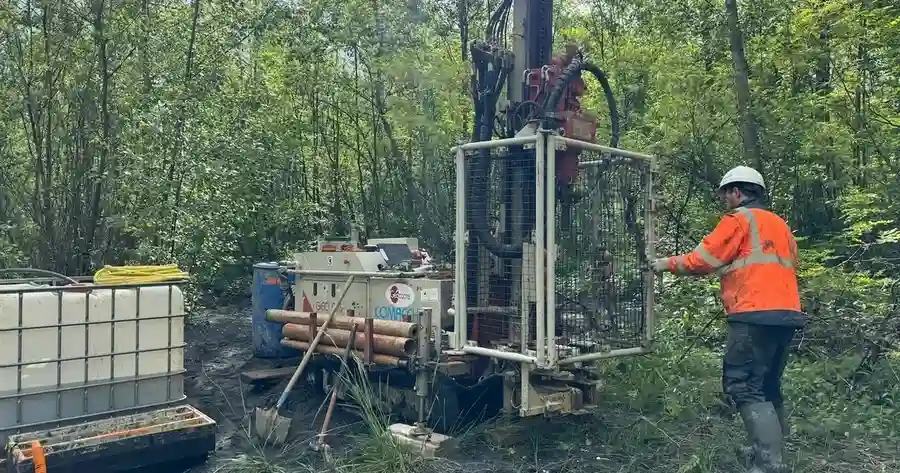
We coordinate the entire chain: U100 open-drive sampling in cohesive soils, window sampling through made ground, and rotary coring into the chalk. The samples are transported under controlled conditions and extruded in our lab within 24 hours to minimise moisture loss and disturbance.

Can you test the brickearth and made ground that appear on many Slough sites?

Yes. Made ground and brickearth are treated with specific preparation protocols — for the brickearth we often use thin-walled tube samples to preserve structure; for made ground we reconstitute specimens to in-situ density and run multistage CU tests to bracket the likely strength range.

Location and service area

We serve projects in Slough and surrounding areas.

View larger map

Test pits and boreholes remain fundamental for capturing subsurface variability, each method providing specific data on stratigraphy and groundwater conditions. Integrating both techniques ensures a robust geotechnical model for foundation design, supported by technical documentation from authoritative sources such as geotechnical engineering.